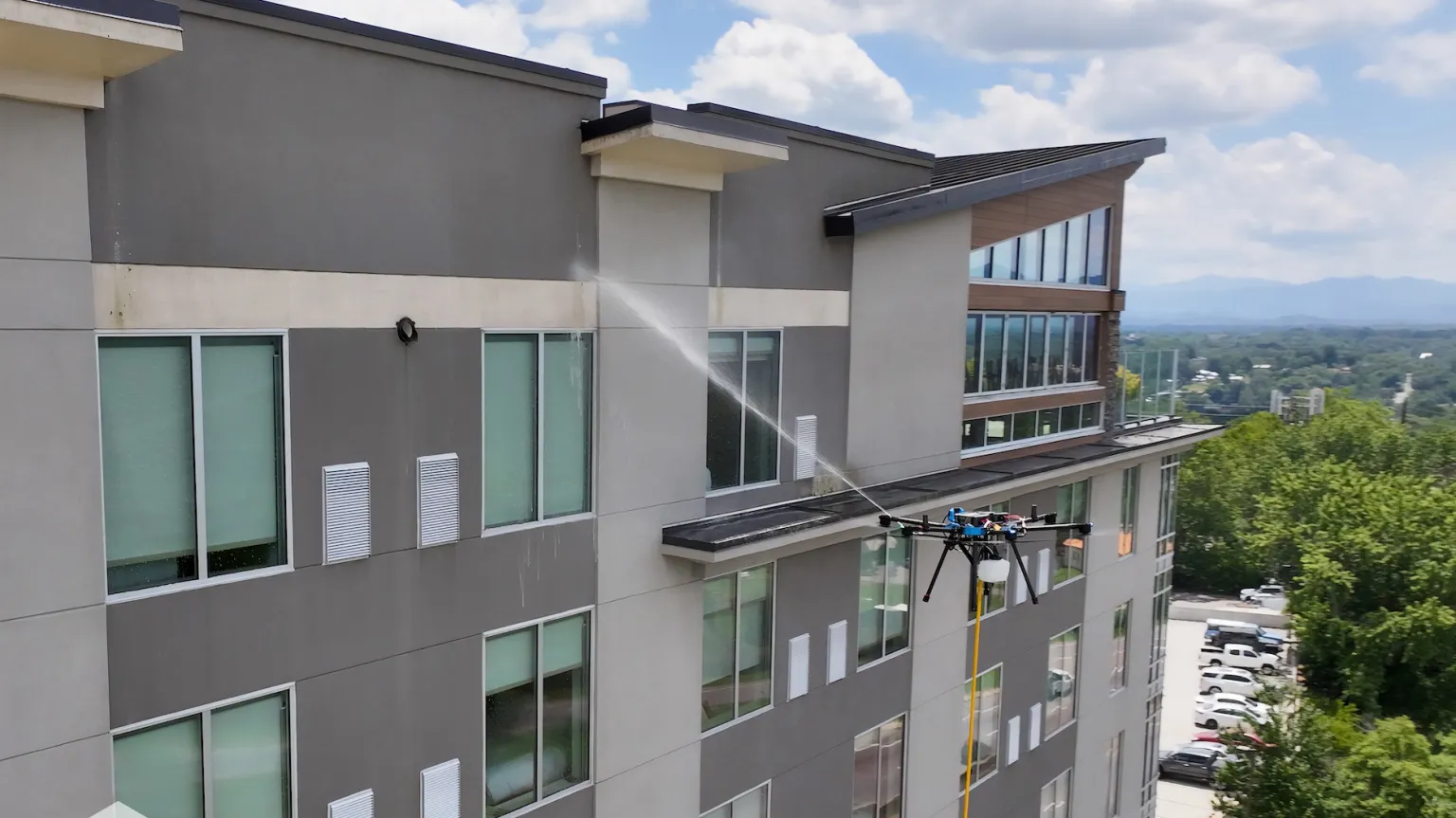
Cleaning skyscrapers, rooftops, and large commercial buildings has always been one of the most physically demanding and risky jobs in the maintenance industry. Workers often work at dangerous heights, in unstable conditions, and perform time-consuming labor. Robotics startup Lucid Bots now wants to modernize the sector using AI-powered automation and intelligent drone systems.
In the first phase of its expansion, the Lucid Sherpa drone platform began attracting attention for helping businesses improve safety and reduce manual cleaning across commercial properties.
Headquartered in Charlotte, Lucid Bots engineers autonomous robots tailored for hazardous, repetitive, or physically challenging tasks.
Why Lucid Bots Is Gaining Attention
Lucid Bots originally launched with a simple mission, to make exterior building cleaning safer and more efficient. Over time, the company evolved into a robotics-focused business, developing autonomous systems capable of operating across multiple surfaces and environments.
Its early products focused on cleaning windows, rooftops, and building exteriors, where traditional crews often face higher safety risks.
Surging customer interest prompted the company to expand its technology into broader cleaning applications.
Businesses began requesting robotic systems capable of cleaning:
- Sidewalks
- Parking lots
- Driveways
- Flat rooftops
- Industrial surfaces
This momentum pushed the company to develop autonomous pressure-washing robots optimized for extensive ground-level cleaning.
AI and Robotics Are Reshaping Commercial Cleaning
Automation is rapidly entering industries that traditionally relied heavily on manual labor. Cleaning and maintenance services are becoming part of this transformation as businesses search for smarter operational solutions.
Rather than solely relying on large crews, robotic systems now empower companies to:
- Improve worker safety
- Reduce operational costs
- Increase cleaning efficiency
- Operate in risky environments.
- Deliver more consistent results.
The company’s robotics integrates advanced software, sensors, and autonomous navigation to perform cleaning tasks more efficiently than traditional methods.
This technology is especially useful for large commercial buildings where exterior maintenance can become both expensive and dangerous over time.
Lucid Bots Expands Beyond Flying Drones
A primary factor attracting investors to Lucid Bots is the company’s capacity to adapt its robust robotics platform into numerous specialized products.
According to company leadership, its robots already share similar hardware structures and intelligent operating systems. That allowed engineers to modify products faster for additional industrial cleaning applications.
The company later introduced a pressure-washing robot capable of cleaning flat surfaces through autonomous movement and smart navigation technology.
This adaptable approach could ultimately enable Lucid Bots to expand into multiple industries beyond property maintenance.
Investors Continue Supporting Robotics Growth
Lucid Bots has recently raised over $9 million in Series A funding as investor enthusiasm for automation startups accelerates.
The funding round was led by Cubit Capital alongside participation from additional venture firms and existing investors.
The new investment will support the company’s next growth phase:
- Expand robotics development
- Improve AI-powered software systems.
- Increase manufacturing operations
- Enter additional commercial markets.
- Scale autonomous cleaning technologies.
The investment signals increasing faith in automation platforms that address tangible labor and safety issues.
Why Cleaning Robotics Could Become a Major Industry
Demand for automation continues to increase as businesses face labor shortages and rising workplace safety concerns.
Industries that involve repetitive physical work are strong targets for robotics innovation, as companies seek ways to improve efficiency while reducing operational risk.
Cleaning robotics may become increasingly important for:
- High-rise buildings
- Industrial facilities
- Warehouses
- Airports
- Stadiums
- Shopping centers
The synergy of AI, robotics, and autonomous navigation empowers companies such as Lucid Bots to thrive in an expanding tech market.
Lucid Bots Focuses on Real Commercial Problems
Unlike some robotics startups centered mainly on speculative concepts, Lucid Bots prioritizes products designed for immediate commercial deployment.
The company has already generated measurable revenue growth while expanding its customer base across commercial cleaning sectors.
Its focus on solving practical industry challenges may help it stand out from competitors operating in more crowded robotics markets.
The Lucid Sherpa drone platform also benefits from operating in environments where drone regulations are often easier to manage than those faced by delivery drone companies, which are subject to stricter restrictions.
Conclusion
Lucid Bots exemplifies how robotics can automate risky, labor-intensive commercial cleaning. Through AI-powered systems and autonomous technology, the company’s mission is to transform industrial maintenance by improving safety, efficiency, and operational outcomes.
With fresh funding, growing customer demand, and expanding commercial applications, the company could play a larger role in the future of industrial maintenance automation.
As robotics adoption spreads into more traditional industries, practical technology solutions may continue attracting both investors and commercial clients.
Frequently Asked Questions
What is the Lucid Sherpa drone?
The Lucid Sherpa drone is an autonomous cleaning drone developed for exterior building maintenance and high-rise cleaning operations.
What does Lucid Bots specialize in?
Lucid Bots develops AI-powered robotics systems to automate dangerous, labor-intensive cleaning tasks.
Why are investors interested in Lucid Bots?
Investors see strong growth potential in automation technology focused on workplace safety and operational efficiency.
How much funding did Lucid Bots raise?
Lucid Bots secured more than $9 million in Series A funding to expand its robotics technology and operations.
