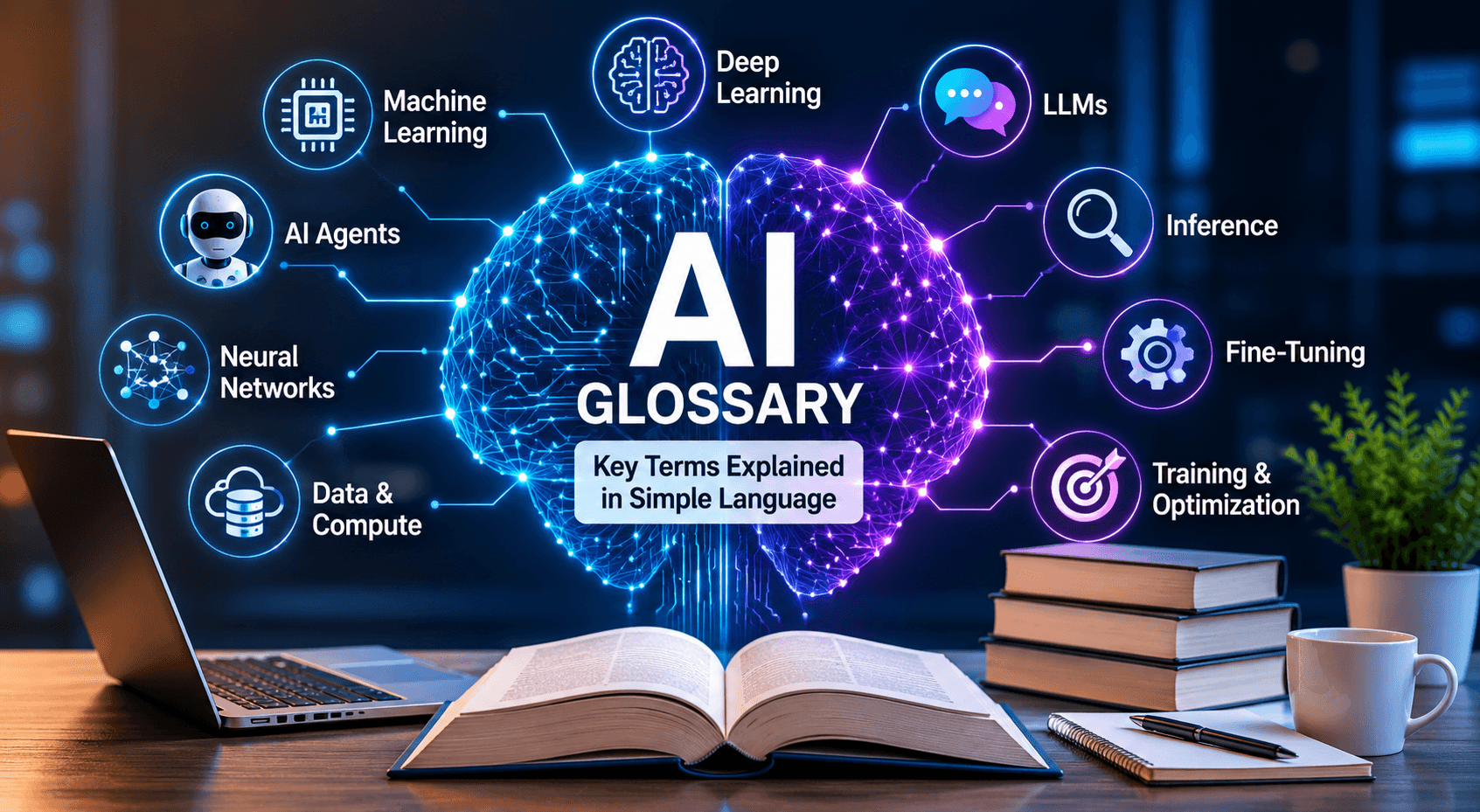
Why AI Terminology Matters in 2026
Artificial intelligence is evolving at an incredible pace, and with every breakthrough comes a wave of new technical terms. Whether you’re reading AI news, exploring new software, or comparing platforms like ChatGPT, Gemini, Claude, or Mistral AI, you’ll often encounter unfamiliar words that can make the technology seem more complicated than it really is.
Understanding these terms is no longer just for AI engineers. Business owners, students, content creators, developers, marketers, and everyday users all benefit from knowing the language behind modern AI. Once you understand the core concepts, it becomes much easier to evaluate AI tools, stay up to date with industry updates, and make informed decisions about adopting AI in your work.
This glossary has been created as a practical learning resource rather than a technical dictionary. Instead of using difficult definitions, each AI term is explained in clear, simple English with real-world context. The goal is to help readers quickly understand how today’s AI technologies work and why these concepts matter as artificial intelligence continues transforming industries in 2026.
Artificial General Intelligence (AGI)
Artificial General Intelligence, commonly known as AGI, refers to a future stage of AI in which a machine can understand, learn, and solve problems across many different subjects at a level similar to or even beyond that of a human being. Unlike today’s AI systems, which are usually trained for specific tasks, AGI would be capable of adapting to completely new situations without requiring separate training for every problem.
Although researchers and technology companies continue working toward this goal, true AGI has not yet been achieved. Today, it remains one of the most discussed topics in artificial intelligence research because of its potential to transform education, healthcare, business, scientific discovery, and many other industries.
AI Agent
An AI agent is an intelligent software system designed to complete tasks with minimal human involvement. Unlike a basic chatbot that simply answers questions, an AI agent can make decisions, carry out multiple actions, interact with different applications, and work toward completing a specific objective.
For example, an AI agent could organize your emails, summarize meeting notes, schedule appointments, and prepare daily reports automatically. As AI technology improves, these systems are expected to become even more capable of handling complex business workflows.
API Endpoint
An API endpoint acts as a communication point between two software applications. It allows one application to send requests to another application and receive information or trigger specific actions without requiring direct human interaction.
For instance, when an AI assistant retrieves weather information, processes online payments, or connects with cloud storage, it often communicates through API endpoints running behind the scenes. These connections make modern AI tools more powerful by allowing them to work with multiple services simultaneously.
Chain of Thought (CoT)
Chain of Thought is a reasoning technique that helps AI solve complex problems by breaking them into smaller logical steps before generating a final answer. Instead of responding immediately, the AI follows a structured thinking process that improves accuracy, particularly for mathematics, programming, and analytical tasks.
Consider asking AI to compare several laptops for programming. Rather than choosing one immediately, the system first reviews specifications, compares performance, evaluates pricing, and then recommends the most suitable option. This structured reasoning process is an example of Chain-of-Thought thinking. Chain-of-Thought reasoning enables advanced AI models to perform these logical processes more effectively, leading to more reliable responses.
Essential AI Terms Explained
Coding Agents
A coding agent is a specialized AI system that assists with software development by handling tasks that usually require manual effort. Instead of only suggesting code snippets, modern coding agents can generate new code, identify bugs, recommend improvements, and even test applications automatically. Some advanced tools can work across an entire project, helping developers save time while reducing repetitive work. However, human review is still essential to ensure the final code is accurate, secure, and meets project requirements.
Compute
In artificial intelligence, compute refers to the processing power required to train and run AI models. The more complex an AI system becomes, the greater its demand for powerful hardware. Technologies such as GPUs, TPUs, and high-performance cloud servers provide the computing resources needed to process massive datasets and generate responses quickly. Without sufficient computing power, even the most advanced AI models cannot perform efficiently.
Deep Learning
Deep learning is a branch of machine learning that enables AI systems to recognize patterns and improve their performance using large amounts of data. It relies on artificial neural networks with multiple processing layers that help machines identify relationships within text, images, audio, and video. This technology powers many modern AI applications, including image recognition, language translation, voice assistants, and autonomous vehicles.
Diffusion Models
Diffusion models are a type of AI technology widely used for generating images, videos, music, and other creative content. They work by learning how data changes over time and then recreating realistic outputs from random noise. Many popular AI image generators use diffusion models because they can produce detailed and visually convincing results while giving users greater creative control.
Distillation
Distillation is a model optimization technique that transfers knowledge from a large AI model to a smaller one. The goal is to create a lightweight model that delivers similar performance while requiring fewer computing resources. This approach allows developers to build faster and more cost-effective AI applications for smartphones, laptops, and other devices with limited hardware capacity.
Fine-Tuning
Fine-tuning is the process of improving a pre-trained AI model for a specific purpose by training it with additional, targeted data. Instead of building a model from the beginning, organizations can customize an existing model to perform better in areas such as healthcare, finance, education, legal services, or customer support. This method reduces development time while producing more accurate results for specialized tasks.
Generative Adversarial Networks (GANs)
Unlike traditional AI models that focus on prediction, Generative Adversarial Networks (GANs) are built to generate entirely new content. They achieve this by using two AI systems that repeatedly evaluate and refine the generated output until it appears more realistic. It works by using two neural networks that continuously challenge each other. One generates content while the other evaluates its quality. This process helps improve the final output over time. Although newer AI technologies are becoming more popular, GANs still play an important role in image enhancement, synthetic media, and research applications.
Hallucination
In artificial intelligence, a hallucination occurs when an AI model produces information that sounds convincing but is actually inaccurate, misleading, or completely fabricated. This usually happens when the model lacks reliable information or incorrectly predicts the next sequence of words. Because of this limitation, users should verify important information, especially when using AI for medical, legal, financial, or scientific purposes.
Inference
Inference is the stage where a trained AI model processes a user’s request and generates a response. Unlike training, which teaches the model using massive datasets, inference applies what the model has already learned to solve new problems. Every time you ask an AI assistant a question, summarize a document, or generate an image, the system is performing inference.
Large Language Models (LLMs)
A Large Language Model (LLM) is an AI system trained on enormous collections of text to understand and generate human language. LLMs power many popular AI assistants and writing tools by helping users answer questions, draft content, translate languages, summarize documents, and assist with coding. Their performance depends on training quality, computing resources, and continuous improvements made by developers.
Model Context Protocol (MCP)
Model Context Protocol (MCP) is an open standard that allows AI systems to communicate with external applications, databases, and digital services through a consistent interface. Instead of building separate integrations for every tool, developers can use MCP to connect AI models with multiple platforms more efficiently. As AI workflows become more advanced, standards like MCP are expected to simplify business automation and software integration.
Mixture of Experts (MoE)
Mixture of Experts (MoE) is an AI architecture that improves efficiency by activating only the most relevant parts of a model for each task. Rather than using every parameter for every request, the system intelligently selects specialized components to handle the job. This approach reduces computing costs while maintaining strong performance, making it an increasingly popular design for modern large AI models.
Memory Cache
A memory cache helps AI systems respond more quickly by temporarily storing frequently used information or calculations. Instead of repeating the same processing every time, the model can reuse previously generated data whenever appropriate. This improves response speed, reduces computing workload, and creates a smoother user experience, particularly during longer conversations or complex tasks.
Neural Network
A neural network is the core technology behind many modern AI systems. It is designed to recognize patterns, process information, and learn from data in a way that is inspired by the connections found in the human brain. Neural networks allow AI to perform tasks such as language understanding, image recognition, speech processing, and predictive analysis. As these networks become larger and more sophisticated, they can solve increasingly complex problems with greater accuracy.
Open Source AI
Open source AI refers to AI software or models whose source code or model weights are made publicly available for developers, researchers, and organizations to inspect, modify, and improve. This approach encourages collaboration, faster innovation, and greater transparency. Many businesses also prefer open-source AI because it offers more flexibility and reduces dependence on a single technology provider.
Reinforcement Learning
Reinforcement learning is a machine learning technique where an AI system improves its performance through continuous feedback. Instead of learning only from examples, the model receives rewards for correct decisions and penalties for poor ones. Over time, it learns which actions produce the best outcomes. This method is commonly used in robotics, game development, autonomous systems, and advanced language model training.
Token
A token is the basic unit of text that an AI model processes during a conversation. A token can represent an entire word, part of a word, a number, or even punctuation. AI systems analyze and generate text by working with tokens rather than complete sentences. Since many AI services charge based on token usage, understanding this concept is useful for both developers and businesses using AI platforms.
Training
Training is the process of teaching an AI model by exposing it to large amounts of data. During this stage, the model learns patterns, relationships, and structures that help it generate useful responses later. The quality and diversity of the training data have a major influence on how accurately an AI system performs in real-world situations.
Transfer Learning
Transfer learning is a development technique that allows an existing AI model to be adapted for a different but related task. Instead of creating a new model from scratch, developers build on the knowledge the model has already learned. This approach reduces development time, lowers training costs, and improves efficiency, particularly when only limited task-specific data is available.
Validation Loss
Validation loss is a performance metric used during AI model development to measure how well a model performs on unseen data. A lower validation loss generally indicates that the model is learning useful patterns instead of simply memorizing its training data. Monitoring this metric helps researchers improve model accuracy while reducing the risk of overfitting.
Weights
In artificial intelligence, weights are numerical values that determine how much importance an AI model gives to different pieces of information while making predictions. During training, these values are continuously adjusted until the model produces more accurate results. Properly optimized weights enable AI systems to recognize patterns more effectively and generate higher-quality outputs.
Takeaways
Artificial intelligence continues to evolve at an extraordinary pace, introducing new technologies and technical terms almost every month. While many of these concepts may appear difficult at first, understanding the basics makes it much easier to follow industry developments and evaluate new AI tools with confidence.
Whether you’re a student, developer, entrepreneur, marketer, or simply curious about artificial intelligence, building a strong understanding of AI terminology is an excellent first step. As AI becomes part of everyday business and personal productivity, knowing these essential concepts will help you stay informed and prepared for future innovations.
Frequently Asked Questions
What is the most important AI term beginners should learn first?
Most beginners should start by understanding Large Language Models (LLMs), AI Agents, and AGI, as these concepts form the foundation of many modern AI applications.
Why is an AI glossary useful?
An AI glossary simplifies technical language, making it easier to understand AI news, compare AI platforms, and learn new concepts without needing an advanced technical background.
How often do AI terms change?
The AI industry evolves rapidly, with new technologies, standards, and terminology appearing every year. Keeping an updated glossary helps readers stay current with the latest developments.
